If you’ve ever wondered, “can you tax a car without insurance?”, you’re not alone. Many car owners find themselves in situations where their insurance has lapsed, expired, or they simply want to pay their vehicle tax before renewing coverage. While it might seem like a simple administrative task, the reality is far more complex. Taxing a car without insurance is not just a bureaucratic hurdle—it can have serious legal and financial consequences if attempted incorrectly.
Understanding the rules around taxing a car without insurance is crucial. Failing to comply with regulations can result in fines, legal action, increased insurance premiums, or even criminal charges in severe cases. Moreover, government systems are increasingly integrated, with insurance databases linked directly to vehicle tax records, making it difficult to bypass this requirement.
In this article, we’ll answer the question “can you tax a car without insurance?” in detail. We’ll also cover what happens if you attempt to do so, explore the potential consequences, and explain legal alternatives to stay fully compliant.
Understanding Car Tax and Insurance Requirements
Before you can fully answer the question, “can you tax a car without insurance?”, it’s important to understand the purpose and legal requirements of both car tax and insurance. These two obligations are closely connected, and failing to meet either can put you at risk.
Car Tax (Vehicle Excise Duty)
Car tax, also known as Vehicle Excise Duty (VED) in some regions, is a mandatory government fee that allows you to legally drive or park your vehicle on public roads. This tax contributes to road maintenance, infrastructure funding, and regulatory oversight of vehicles.
The amount you pay is not fixed—it depends on several factors, including:
- Vehicle type: Cars, motorcycles, vans, and commercial vehicles often have different tax rates.
- Engine size: Larger engines generally attract higher tax.
- CO2 emissions: Many countries use emissions-based tax systems to encourage environmentally friendly vehicles.
- Vehicle age: Older vehicles may have lower rates in some jurisdictions or special exemptions in others.
Failing to pay car tax can result in fines, vehicle clamping, or impoundment. More importantly, many countries now require proof of insurance before issuing or renewing car tax, making it impossible to legally tax a car without coverage.
Car Insurance
Car insurance is another legal requirement designed to protect drivers, passengers, and other road users in the event of an accident. Most countries mandate at least third-party insurance, which covers damages you may cause to other people, their vehicles, or property.
Insurance is closely linked with car tax because:
- It ensures that vehicles on public roads are financially covered in case of accidents.
- Insurance status is often verified automatically during the vehicle tax or registration process.
- Many online systems prevent car tax payments without proof of valid insurance.
Skipping insurance to pay your vehicle tax can therefore not only fail to accomplish your goal but also expose you to legal, financial, and administrative consequences.
Key point: Taxing a car without insurance is not just risky—it’s generally blocked by government systems designed to prevent untaxed or uninsured vehicles from being on the road. Attempting to bypass these systems can result in fines, penalties, or even criminal charges, depending on your jurisdiction.
Can You Tax a Car Without Insurance?
So, the critical question remains: can you tax a car without insurance? While it might seem like a simple administrative step, the reality is more complex. In most countries, the answer is a firm no. Modern government systems are designed to check your insurance status before allowing any car tax payment, making it virtually impossible to bypass this requirement legally.
United Kingdom (UK)
In the UK, the DVLA (Driver and Vehicle Licensing Agency) requires proof of valid insurance before issuing or renewing vehicle tax. The system is connected to insurance databases, so if your policy has lapsed, your attempt to tax the car will be automatically blocked. This is designed to prevent uninsured vehicles from being driven or parked on public roads, protecting both you and other road users.
United States (US)
In the US, the situation varies by state, but most states link insurance verification to vehicle registration, which acts as the functional equivalent of car tax. Without valid insurance, your registration renewal will be denied, and in some states, you may even receive notifications warning that driving without insurance is illegal and subject to fines.
Other Countries
Many other countries have adopted similar online verification systems. In places like Australia, Canada, and parts of Europe, insurance databases are often directly integrated with vehicle tax systems. Attempting to pay car tax without insurance in these regions is either technically impossible or considered fraudulent.
Trying to bypass these checks to tax a car without insurance can lead to serious consequences, both legally and financially.
What Happens if You Try to Tax a Car Without Insurance?
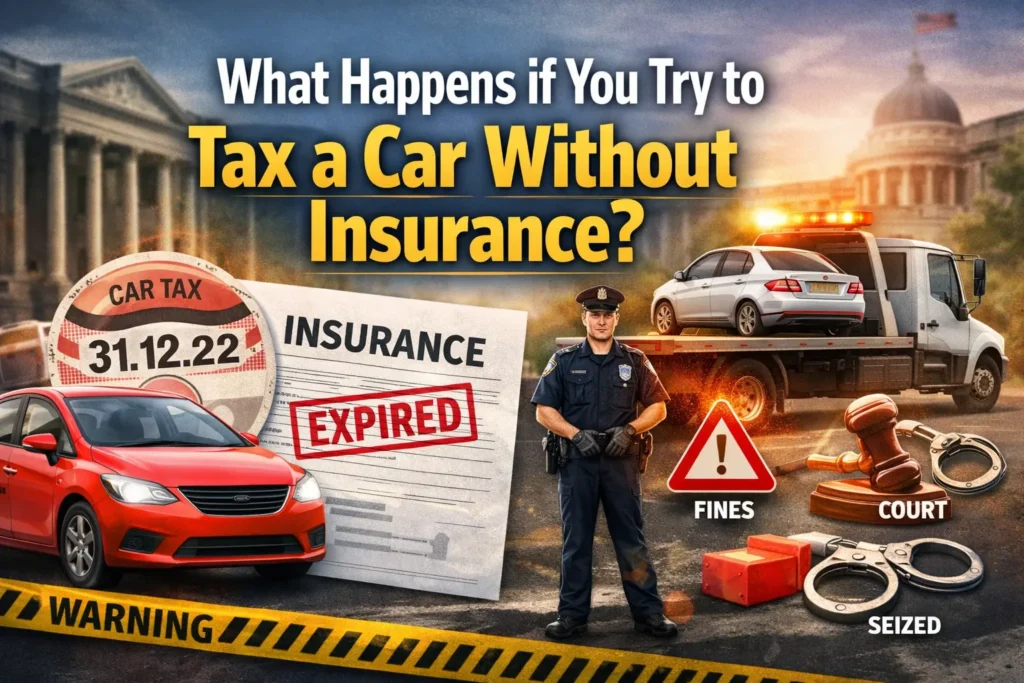
If you attempt to tax a car without insurance, the consequences can range from administrative setbacks to legal penalties. Here’s what you can expect:
1. Transaction Denial
Most online and in-person government systems are connected to insurance databases. Without valid coverage, your application to tax the car will likely be automatically rejected, preventing you from completing the process. Even if you try in person, clerks may require proof of insurance before processing your payment.
2. Fines and Penalties
If you somehow manage to pay the tax without valid insurance—through a system error or oversight—authorities can impose:
- Financial fines: These can be substantial and vary depending on your country or state. In some cases, fines for attempting to tax an uninsured car can run into hundreds or even thousands of dollars/pounds.
- Backdated tax cancellation: Your payment may be revoked retroactively. You could be required to repay the correct tax amount once insurance is verified, often with additional late fees.
3. Legal Action
Driving an untaxed and uninsured car is illegal in most jurisdictions. Potential legal consequences include:
- Court summons: You may be called to appear in court to answer for the violation.
- Points on your driving license: Many countries impose penalty points, which could affect your insurance premiums and driving privileges.
- Vehicle seizure or impoundment: Authorities can legally seize your vehicle until it is properly insured and taxed.
4. Increased Insurance Premiums
Insurance companies view attempts to bypass insurance requirements as high-risk behavior. Even if you are caught attempting to tax your car without insurance without driving it, insurers may:
- Increase your premiums for future coverage
- Refuse coverage altogether for certain policies
5. Criminal Charges
In severe cases, particularly if fraud or deliberate deception is involved, you could face criminal prosecution. This is more likely if the car is driven on public roads while uninsured, or if multiple violations occur over time. Criminal charges could result in hefty fines, a criminal record, or even imprisonment in extreme situations.
Legal Alternatives to Taxing a Car Without Insurance
If you’re wondering how to remain compliant and avoid legal issues when your insurance lapses, there are several legal alternatives to consider. These options allow you to stay within the law while managing your vehicle tax responsibilities safely.
1. SORN (Statutory Off Road Notification) – UK Example
In the UK, one of the most common ways to legally avoid paying car tax while your insurance has lapsed is to declare your vehicle off the road using a Statutory Off Road Notification (SORN).
- Declaring a car as SORN means you do not need to pay vehicle tax or maintain insurance while the car is parked and not being driven on public roads.
- This option is particularly useful if your vehicle is being stored, undergoing repairs, or temporarily out of use.
- Once you are ready to drive again, it’s mandatory to obtain valid insurance and pay the appropriate car tax before using the vehicle legally on public roads.
SORN provides a safe and legal method for avoiding unnecessary fines or penalties while your car is temporarily off the road.
2. Short-Term or Temporary Insurance
Another practical solution is short-term or temporary insurance.
- Many insurance providers offer coverage that lasts from a few days up to several weeks.
- This allows vehicle owners to legally pay their car tax while bridging a gap between regular insurance policies.
- Temporary insurance is ideal for situations such as renewing your regular insurance, buying a second-hand car, or needing coverage for a short trip.
By using temporary insurance, you can legally answer the question, “can you tax a car without insurance?”, because your short-term policy satisfies the requirement for valid coverage.
3. Ensure Continuous Insurance Coverage
The most reliable and straightforward method is to maintain continuous insurance coverage.
- Many countries directly link vehicle tax renewal to active insurance policies. Without valid coverage, you cannot legally complete the tax payment.
- Continuous coverage not only keeps you compliant but also avoids the risk of fines, license points, or legal complications.
- It is recommended to plan ahead and ensure your insurance does not lapse before your vehicle tax is due.
Maintaining uninterrupted insurance ensures that your vehicle remains fully legal for both driving and taxing purposes.
Final Thoughts
So, can you tax a car without insurance? The short answer is no, in almost all cases. Attempting to bypass insurance requirements can result in denied transactions, financial penalties, legal action, and even criminal consequences in severe cases.
By understanding the rules and using legal alternatives such as SORN, temporary insurance, or continuous coverage, you can stay fully compliant while avoiding unnecessary stress and penalties.
Always ensure your vehicle is both insured and taxed before driving. Skipping either step is not just risky—it’s illegal. Staying proactive with your insurance and vehicle tax ensures peace of mind, protects you from fines, and keeps you fully compliant with the law.